Birds in Backyards

Spotted Pardalote investigating cavity in mortar in brick wall. Spotted Pardalote investigating cavity in mortar in brick wall.
Photo: Holly Parsons © Holly Parsons

Spotted Pardalote, with nesting material in its beak. Spotted Pardalote, with nesting material in its beak.
Photo: K Vang and W Dabrowka / Bird Explorers © K Vang and W Dabrowka / Bird Explorers

Distribution map of Pardalotus punctatus Distribution map of Pardalotus punctatus
Map © Birds Australia Birdata

Did you know?

The Spotted Pardalote is sometimes known as the "Headache Bird" because of the continuous "sleep-may-be" call it gives during the breeding season.

Facts and figures

Research Species: No
Minimum size: 8 cm
Maximum size: 10 cm
Average size: 9 cm
Average weight: 8 g
Breeding season: June to January
Clutch size: 4
Incubation: 19 days
Time in nest: 21 days

Calls

Repeated three-note whistle, the second two notes higher than the first.

Call in MP3 format (249kb)
Copyright © Fred Van Gessel

Conservation status

Federal - Secure
NSW - Secure

Status of Australian Birds

Plants associated with this species

Eucalyptus

Spotted Pardalote

Scientific name: Pardalotus punctatus
Family: Pardalotidae
Order: Passeriformes

Featured Bird Groups
Small insect-eating birds
Top 40 bird songs

What does it look like?

Description

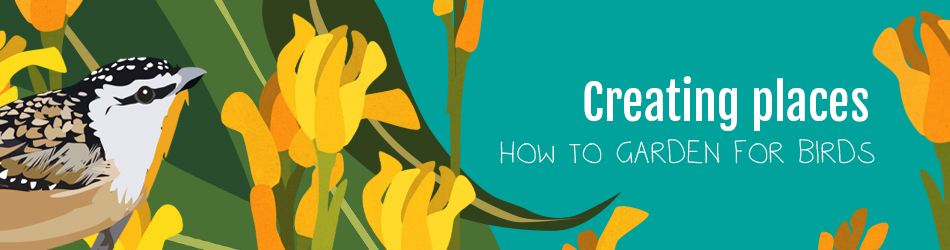
The Spotted Pardalote is a tiny bird that is most often high in a eucalypt canopy, so it is more often detected by its characteristic call. The wings, tail and head of the male are black and covered with small, distinct white spots. Males have a pale eyebrow, a yellow throat and a red rump. Females are similar but have less-distinct markings.

Similar species
The related Striated Pardalote, P. striatus, has a striped head rather than spotted, and lacks the spotting on the wings and has a plainer back.

Where does it live?

Distribution

The Spotted Pardalote is found in eastern and southern Australia from Cooktown in Queensland through to Perth in Western Australia. It occurs in coastal areas, extending to the western slopes of the Great Dividing Range in the east.

Habitat

The Spotted Pardalote is mostly found in eucalypt forests and woodlands but occurs in parks and gardens with well-established eucalypt canopy.

Seasonal movements

Largely sedentary, but may undergo local seasonal movements away from higher elevations in autumn/winter.

What does it do?

Feeding

The Spotted Pardalote forages on the foliage of trees for insects, especially psyllids, and sugary exudates from leaves and psyllids.

Breeding

The Spotted Pardalote's nest is an enlarged, lined chamber at the end of narrow tunnel, excavated in an earth bank. Sometimes they nest in tree hollows and occasionally in artificial structures. Both parents share nest-building, incubation of the eggs and feeding of the young when they hatch.

Living with us

Living with humans

The Spotted Pardalote remains relatively common in urban areas that have a high density of eucalypts. Nests have sometimes been found in carpet rolls and garage roll-a-doors.

Urban habitat requirements

A high density of eucalypts.

References

Simpson, K and Day, N. 1999. Field guide to the birds of Australia, 6th Edition. Penguin Books, Australia.

Rowland, P. 1996. A Photographic Guide to Birds of Australia. Australian Museum/New Holland.

Higgins, P.J. and J.M. Peter (eds) 2002. Handbook of Australian, New Zealand and Antarctic Birds, Volume 6: Pardalotes to Shrike-thrushes. Oxford University Press, Melbourne.

Members