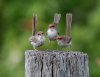
Yellow Wattlebird, male.
Photo: Purnell Collection © Australian Museum
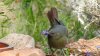
Yellow Wattlebird, female.
Photo: Purnell Collection © Australian Museum
Distribution map of Anthochaera paradoxa
Map © Birds Australia Birdata
Yellow Wattlebird
Scientific name: Anthochaera paradoxa
Family: Meliphagidae
Order: Passeriformes
- Featured Bird Groups
- Honeyeaters
What does it look like?
Description
The Yellow Wattlebird is Australia's largest honeyeater. It is a slim bird with a long tail, a short strong bill and distinctive yellow-orange wattles on the sides of the head. These wattles become larger and brighter during the breeding season. Adults are dark brown above, with a pale face, strongly streaked brown and white head, and white below with heavy dark streaks on the breast and sides.The belly has a prominent yellow patch. Females (40 cm) are noticeably smaller than males (46 cm). Young birds have a much paler head, smaller wattles and a browner underbody. This species is only found in Tasmania and is also known as the Tasmanian Wattlebird.
Similar species
The only similar species in Tasmania is the much smaller and darker Little Wattlebird, A. chrysoptera. This species also lacks the yellow wattles and belly patch.
Where does it live?
Distribution
The Yellow Wattlebird is endemic to Tasmania. It is widespread in the eastern and central areas, but is rarely found in the west or south-west. It is also widespread on King Island and is found on Three Hummock and Hunter Islands.
Habitat
The Yellow Wattlebird is found in a variety of habitats from sea level to the subalpine zone (up to 1350 m altitude). It is found in dry and wet forests, woodlands, alpine forests and coastal heaths. It is common in urban parks and gardens, as well as open spaces such as reserves, cemeteries and golf courses.
Seasonal movements
Nomadic outside of breeding season, with autumn-winter flocks moving to lower areas. Often visit urban gardens during autumn and winter, and may move in response to the flowering pattern of preferred food trees.
What does it do?
Feeding
The Yellow Honeyeater feeds mainly on the nectar of eucalypts and banksias. It will also eat fruit and insects. It forages at all levels of the canopy, from the top of trees to near ground level. Will visit gardens and orchards to feed on introduced fruits and flowers, mainly eating overripe or fallen fruits. It sometimes feeds in small flocks, and may feed with Little Wattlebirds and other honeyeaters attracted to common food sources such as manna (sweet secretions) from the Cider Gum, Eucalyptus gunnii.
Breeding
The Yellow Wattlebird nests in breeding pairs which aggressively defend their breeding territories against other birds. The female alone constructs the open, bowl-shaped nest of thin twigs, bark and grass, lining it will bark, roots, grass and mammal fur or wool. The nest is placed about 3 m - 20 m above the ground, often in an exposed tree fork, usually in eucalypts. Both sexes incubate the eggs and feed the young, continuing to feed fledglings for a few weeks. In coastal areas two broods may be raised in the one season, while in central areas usually one brood is raised.
Living with us
Living with humans
The Yellow Wattlebird prefers older forests, and may be adversely affected by increased fire frequency. Has been adversely affected by land-clearing on King Island. Early in the twentieth century, numbers declined alarmingly when hunted as game and the species was regularly hunted until the early 1970s. It is however common in urban open spaces.
References
Higgins, P.J., Peter, J.M. and Steele, W.K. (eds) 2001. Handbook of Australian, New Zealand and Antarctic Birds, Volume 5 (Tyrant-flycatchers to Chats). Oxford University Press, Melbourne.
Simpson, K and Day, N. 1999. Field guide to the birds of Australia, 6th Edition. Penguin Books, Australia.